
We wanted to take a moment and wish all of our subscribers and their families a very Happy Thanksgiving. Environmental Law Monitor will return next Thursday (12/3) with new posts. Once again, Happy Thanksgiving!…
Continue Reading
We wanted to take a moment and wish all of our subscribers and their families a very Happy Thanksgiving. Environmental Law Monitor will return next Thursday (12/3) with new posts. Once again, Happy Thanksgiving!…
Continue Reading
As the coronavirus continues to spread across the nation, states throughout the country are ordering citizens to stay at home and not report to work. All orders, however, contain carve out exceptions for essential or life-sustaining activities, such as providing health care, medicine, and food. Yet, these orders have created much uncertainty as to what constitutes essential or life-sustaining activities. Arguably, many activities not directly related to containment of the coronavirus are still essential and/or life-sustaining. As with every aspect of the country’s economy, the coronavirus …
Continue Reading
If you’ve been following PFAS-related news you’ll know that Michigan has been one of the hardest hit states when it comes to this emerging contaminant. The state is one of a handful in the nation to take the lead in attempting to set some of the nation’s toughest drinking water limits for per- and polyfluoroalkyl substances (PFAS).
Earlier this year, a Michigan state sponsored scientific workgroup proposed new health threshold limits for various PFAS compounds as Michigan seeks to set some of the most stringent enforceable …
Continue Reading
This blog frequently addresses emerging contaminants, most prominently the PFAS compounds and 1,4-dioxane. As these chemicals become more notorious through testing, regulation, and public scrutiny, they’ll likely become more prolific factors in the purchase and sale of real estate. As our readers know, PFAS is almost ubiquitous: it is nearly everywhere (in varying concentrations). As we continue to report on other contaminants, like 1,4-dioxane, it appears the trend is to continue to elevate the focus on these chemicals. So, how should a prospective purchaser, and …
Continue Reading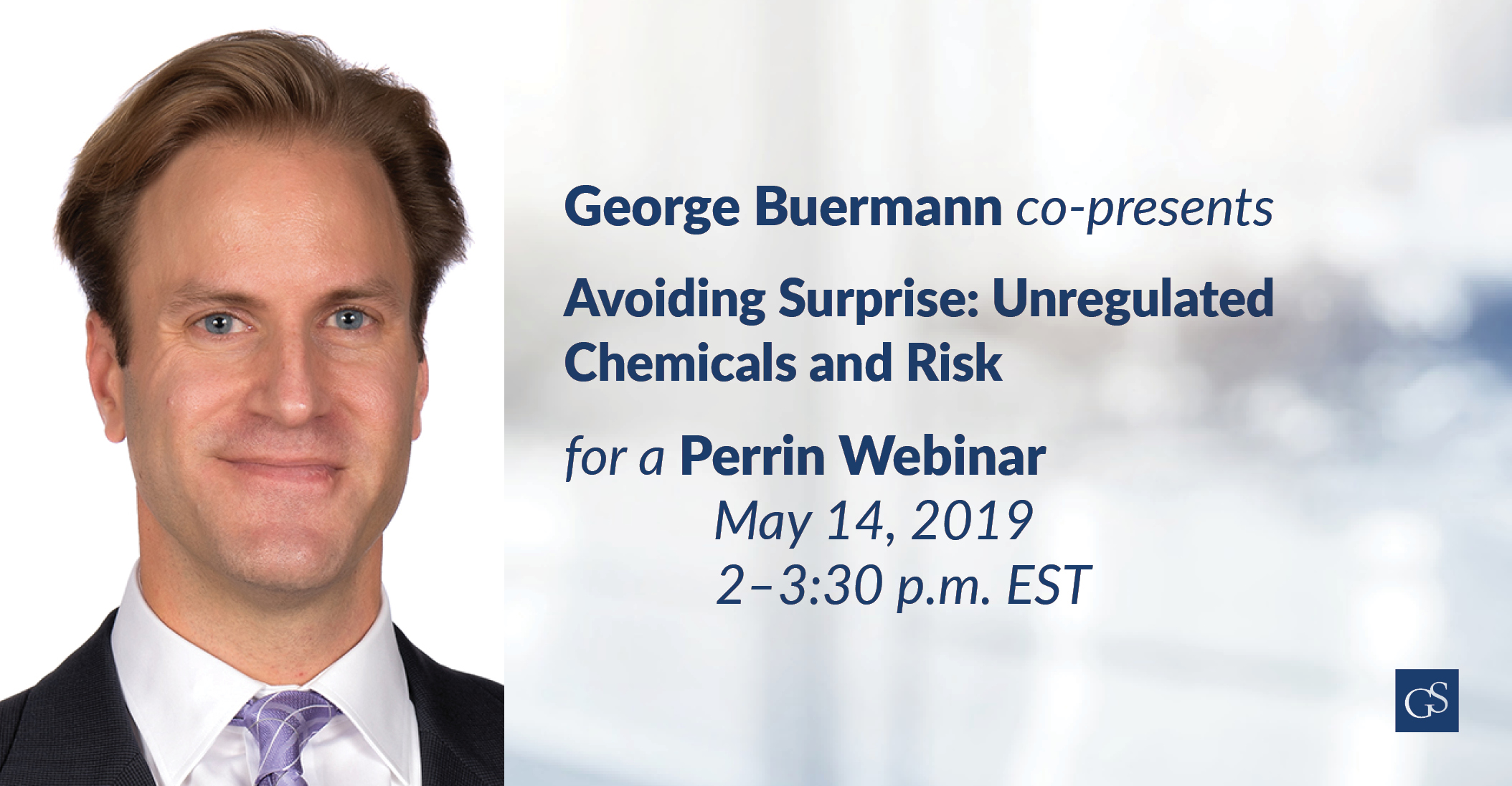
Co-Editor George Buermann be co-presenting a Perrin webinar titled “Avoiding Surprise: Unregulated Chemicals and Risk” on May 14, 2019 from 2 – 3:30 p.m. EST.
This webinar will cover the following topics:
Learn more and register here.…
Continue Reading
The City of Newark, NJ has been battling an aging and decaying infrastructure for years. More specifically, Newark’s aging water supply and service line infrastructure is one of many challenges it, and other similarly situated cities face.
The issue of lead in drinking water captured the nation’s attention several years ago with the heath crisis that impacted (and is still impacting) Flint, Michigan. The concern involving drinking water quality and excessive lead levels is, however, far from limited to that region.
Last year, Newark reported …
Continue Reading
On June 26, 2018, the Natural Resources Defense Council (NRDC) and a New Jersey based teachers’ caucus joined forces to file a lawsuit in federal district court alleging, among other things, that the City of Newark’s water system contains dangerous elevated levels of lead that’s putting the health of residents in the community at risk.
As many of our readers are aware, NRDC is the nonprofit organization that brought a citizen suit (along with the ACLU) under the SDWA against the City of Flint, MI …
Continue Reading
We’ve posted on several occasions about the ongoing litigation over GenX contamination emanating from the Chemours Fayetteville Works facility along the Cape Fear River in North Carolina.
The damages that defendants typically face in these trending water contamination actions arise not only from cleanup costs to the waterbody at issue, but from the impact to the surrounding communities —ranging from PI, damage to real property/diminution in value, natural resources, and medical monitoring. There’s also another type of damages in the form of equitable relief. Last …
Continue Reading
A couple of random things you might not know about Jersey.
We’ve got great tomatoes, corn, and peaches, and some of the strictest environmental regulations in the country. By way of example, the NJ DEP now leads the nation in setting the lowest Maximum Contaminant Limits (MCL) of 14 parts per trillion (ppt) for PFOAs (perfluorooctanoic acid) — a chemical used in the manufacture of consumer products that essentially everyone has used, such as nonstick cookware, food packaging, stain resistant furniture, dental floss, breathable fabrics, …
Continue Reading
On June 20, 2017, the Chemours Company announced that it will now “capture, remove, and safely dispose of wastewater that contains the byproduct GenX,” from North Carolina’s Cape Fear River — a main supply source for the City of Wilmington’s drinking water.
The announcement last week comes on the heels of reports that the EPA is investigating whether Chemours complied with a 2009 order issued under the Toxic Substances Control Act (TSCA) that allowed DuPont (from which Chemours was spun-off) to produce GenX in its …
Continue Reading